
Sep 18, 2025
Case study: a target-specific blocking antibody removed false-positive ADA signals caused by soluble drug target in four of five serum samples.
 \
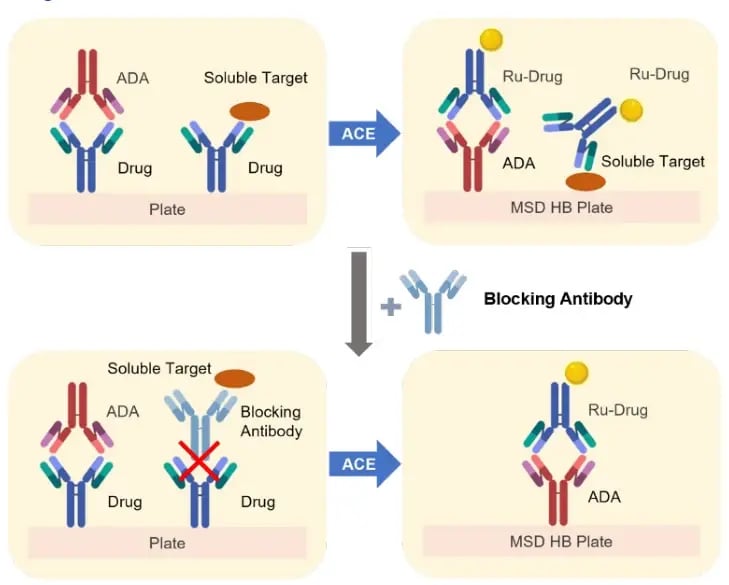
Summary: In an affinity capture elution (ACE) ADA assay on the MSD platform, adding a target-specific blocking antibody after acid dissociation removed false-positive signals caused by soluble target protein in four of five serum samples.
Objective
Therapeutic proteins carry a higher immunogenicity risk than small molecules, and ADA can reduce exposure and efficacy or cause adverse events. Soluble drug target in the sample can also bridge the labeled drug and produce false-positive ADA results. This study developed a strategy to remove that interference.
Challenge
Soluble target present in study samples can generate false-positive ADA results, which affects immunogenicity reporting and the interpretation of PD, efficacy and safety.
Approach
In an ACE ADA assay on the MSD platform, acid-dissociated samples were treated with a specific antibody that blocks the soluble target, preventing it from being captured and eluted with the ADA.
Results
| PC (ng/mL) | 100 µg/mL drug | 300 µg/mL drug | 500 µg/mL drug |
|---|---|---|---|
| 900 | Positive | Positive | Positive |
| 300 | Positive | Positive | Positive |
| 100 | Positive | Negative | Negative |
| 30 | Negative | Negative | Negative |
| 0 | Negative | Negative | Negative |
The assay detected 100 ng/mL PC in the presence of 100 µg/mL drug, and 300 ng/mL PC in the presence of at least 500 µg/mL drug.
| Serum sample | Basal level, no blocking antibody | Basal level + blocking antibody | +20 µg/mL target + blocking antibody | +50 µg/mL target + blocking antibody |
|---|---|---|---|---|
| Serum 01 | Positive | Negative | Negative | Negative |
| Serum 02 | Positive | Negative | Negative | Negative |
| Serum 03 | Positive | Negative | Negative | Negative |
| Serum 04 | Positive | Positive | Positive | Positive |
| Serum 05 | Positive | Negative | Negative | Negative |
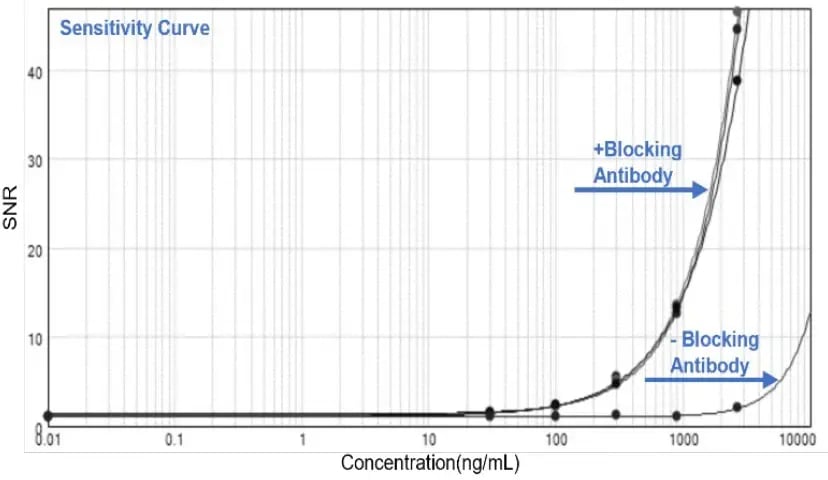
Without the blocking antibody, all five sera screened positive. With the blocking antibody, four of five became negative, including after spiking 20 or 50 µg/mL of target, consistent with soluble target interference. Serum 04 remained positive under all conditions.
Conclusions
Treating samples with a target-specific blocking antibody is an effective way to reduce soluble target interference in ADA assays for therapeutic proteins.
Related services: ADA and NAb immunogenicity assays.
Download the case study
Fill in the short form below and we will email you the PDF (1 page, 659 KB).
To discuss a similar study, email cbs_bd@crystalpharmatech.com or call +1 925-558-5040.