Developability Assessment for Biologics
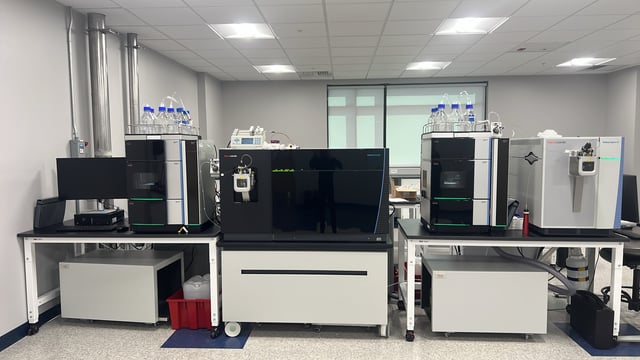
Developability assessment identifies chemical and biophysical risks in a biologic candidate before they become manufacturing, formulation or clinical problems. Crystal Bio Solutions, part of Crystal Group, runs chemical and biophysical developability panels for antibodies, antibody fragments and VHHs, multispecifics and other proteins in our biologics CMC analytical laboratory in Natick, Massachusetts, with results compared against predefined targets to support candidate selection.

Where Developability Fits
- Discovery: screening and initial developability and risk assessment to rank candidates
- Lead selection: full chemical and biophysical panels against predefined targets
- Preclinical development: pre-formulation, stability and serum stability
- Transition to CMC: liabilities and methods carry forward into the IND analytical package
Finding a liability at this stage usually means choosing or engineering a different candidate. Finding it after manufacturing has started can mean reformulation or comparability work.
Related reading: HRMS in Biologics Characterization
Related Services
Frequently Asked Questions
What is a developability assessment?
A developability assessment evaluates whether a biologic candidate can be manufactured, formulated, stored and delivered reliably. It measures chemical stability, such as oxidation and deamidation, and biophysical behavior, such as aggregation, thermal stability, self-interaction and viscosity, usually to compare candidates before one is selected.
When should developability be assessed?
During discovery and lead optimization, before a single candidate is selected. Problems found then can often be solved by choosing another candidate or changing the sequence, which costs much less than addressing them after manufacturing has started.
What is the difference between chemical and biophysical developability?
Chemical developability looks at covalent changes, such as oxidation, deamidation, isomerization and clipping, followed by SEC, HIC, cIEF, CE-SDS, intact mass and peptide mapping. Biophysical developability looks at physical behavior such as thermal stability, aggregation, self-interaction, viscosity, opalescence and response to agitation or interfaces.
Why study viscosity and opalescence at high concentration?
Many antibodies are given subcutaneously at high concentration. High viscosity makes manufacturing and injection difficult, and opalescence can indicate self-association. Measuring both early helps select candidates suited to the intended formulation.
What does kD tell you?
The diffusion interaction parameter (kD), measured by DLS, indicates whether molecules attract or repel each other in solution. Attractive self-interaction is associated with higher viscosity, opalescence and aggregation risk at high concentration.
Can developability panels be applied to VHHs, multispecifics and ADCs?
Yes. Panels are adapted to the format. For VHH-containing molecules, for example, peptide mapping focuses on known liability sites in the CDRs, such as methionine oxidation and aspartate isomerization.
Where does Crystal Bio Solutions perform developability work?
Developability assessment is performed in the CBS biologics CMC analytical laboratory in Natick, Massachusetts.